原标题:尾号666666666,底价1366万元,这个手机号被拍卖近日,某线上拍卖平台上线了“中国6最多,最顺利号码,联通手机靓号15666666666”。
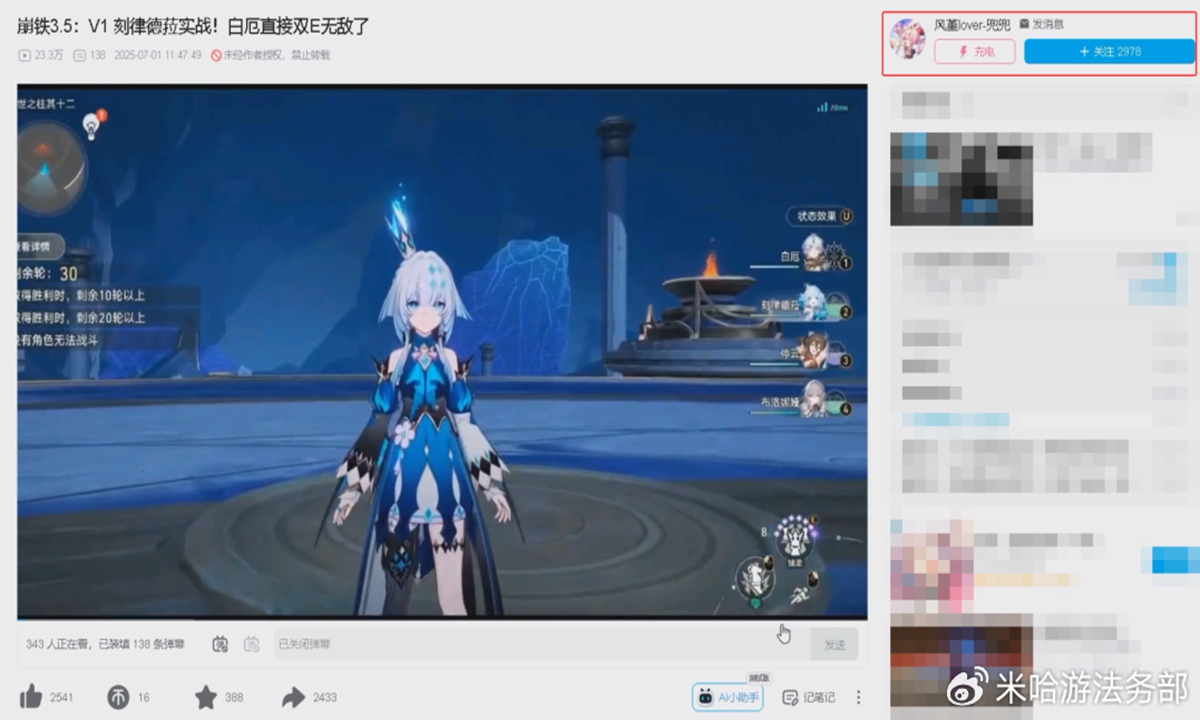
Two Bilibili (Chinese video-sharing platform) users were found guilty of copyright infringement and were sentenced to one year and two months and one year in prison, respectively, both with probation. Photo: Courtesy of miHoYo
A criminal case involving information leaks related to miHoYo, the developer of
Genshin Impact, has reached its first-instance verdict. Two Bilibili (Chinese video-sharing platform) users were found guilty of copyright infringement and were sentenced to one year and two months and one year in prison, respectively, both with probation. It is the first criminal game leak case under a new judicial interpretation issued by China's top judicial authorities, according to miHoYo.
The infringing videos uploaded by Su and Wu received more than 600,000 and 300,000 views, respectively, exceeding the criminal prosecution thresholds stipulated under the judicial interpretation. The court therefore found that the two individuals met the criteria for criminal prosecution and handed down guilty verdicts.
During routine monitoring, in July 2025, miHoYo discovered that Su and Wu had repeatedly uploaded gameplay videos featuring unreleased versions of miHoYo titles, including
Genshin Impact, Honkai: Star Rail and
Zenless Zone Zero, without any authorization from the company. The videos, widely circulated within gaming communities, exposed unreleased characters, skill animations and other content that had not yet been officially introduced to players, miHoYo noted.
After discovering the alleged violations, miHoYo reported the case to the police in accordance with legal procedures. Following an investigation, the police arrested the two individuals involved.
The case was publicly heard and the verdict was delivered on April 24, 2026. The court ruled that Su was to be sentenced to one year and two months in prison with probation, while Wu was sentenced to one year of detention with probation, according to miHoYo.
Guo Hao, a Beijing-based lawyer, told the Global Times on Thursday that a key significance of the case lies in its further clarification of how game leak cases can be assessed under the Criminal Law.
"In the past, game leaks were more often handled through civil infringement claims or breach-of-contract disputes. In this case, however, the court did not simply determine liability based on whether content was released ahead of schedule," Guo said. "Instead, it considered factors including the scale of dissemination, the nature of the leaked content and the impact caused, and determined that the conduct met the prosecution threshold for the crime of copyright infringement."
Similar game leak incidents have also occurred overseas in recent years. In October 2024, The Pokemon Company suffered a data breach that resulted in large amounts of internal information being leaked online, including employees' personal information, according to overseas media reports. Dubbed the "Teraleak" by the gaming community, the incident was reportedly one of the largest game-related leaks in recent years. The leaked materials reportedly included game source codes, details of future projects and other internal information, according to Nintendo Life, a UK-based gaming news outlet.
Earlier, Nintendo had pursued legal action over the leak of a
Pokemon Sword and Shield strategy guide in 2019. According to gaming website Polygon, The Pokémon Company later reached a settlement with the two individuals responsible, who were required to pay $150,000 each in damages.
"From a player's perspective, there is a clear difference between game leaks and normal game discussions," Lu, a member from the Steam gaming community, told the Global Times on Thursday. "Players discussing and analyzing officially released information is part of gaming culture, but obtaining and spreading unreleased content through unauthorized channels can harm the efforts of developers and affect the experience of the entire player community."
Such concerns are also shared by game developers, who view unreleased content as a key part of their creative and commercial plans.
A post by miHoYo on its online account specifies that every unreleased frame of game content represents the design and refinement efforts of its creative teams, while also carrying players' expectations for upcoming updates. Unauthorized early exposure of such content not only infringes upon miHoYo's copyright interests, but also takes away the surprise that players should have when experiencing new content for the first time.
。起拍价1366万元,保证金68.8万元。此次拍卖将于10月10日10时开始,截至9月13日上午10点50分,已有9968次围观,204人设置提醒。根据竞买公告,该号码的归属地为山东济南,号码使用权无任何纠纷,剩余话费余额380000余元不包含在本次拍卖成交价中。公告中还特别提醒,该电话号码目前正常使用,请各竞买人切勿恶意拨打电话、短信骚扰等,以免造成他人困扰,如有恶意拨打骚扰电话、骚扰短信等,将承担相关法律责任。据媒体公开报道,此前,该拍卖平台拍出过一个号码为“15077777777”的手机靓号,成交价为391万元。据悉,手机号码由工信部统一规划,由3位网号(代表运营商)+4位HLR号(代表归属地)+4位的个人代码组成。吉祥号码是怎么来的?作为吉祥号码的发放方,电信运营商又是怎么处理这些“靓号”的呢?据上游新闻,记者采访了重庆移动相关负责人谢先生,他表示,根据移动公司规定,采用透明、公开的方式处置吉祥号:一般情况下,是由用户主动向运营商提出申请,并根据规定承诺消费额度,或预存一定话费,便有机会获得吉祥号码。谢先生还表示,移动公司不提倡用户之间把号码用于交易,但是并没有明确禁止,并且为用户提供过户的服务,以保证手机号码实名制。“靓号”如何评估价格?重庆华康资产评估公司的相关人士李先生表示,虚拟资产的评估一般采用现行市价法,通过比较被评估该虚拟资产与最近售出类似资产的异同,并将类似资产价格进行调整,从而确定被评估虚拟资产价值。他举例称,如果一个号码拥有5个8,它的交易价格就会去参照之前成交过的有5个8的号码,通过比较定价。

二 | 综合:新黄河客户端、上游新闻来源:掌上济南返回搜狐,查看更多责任编辑:
Current article:http://www.minpinpengcemiuanjiuxuan.pics/ttyd9xv/20260826/6543.doc

