
极度深寒
Birthday Special: Movies Starring Dharmendra and Sharmila Tagore Together_我的网站

A | He was considered the most handsome star of his era and she was said to be the most beautiful actress. No wonder the jodi of Dharmendra and Sharmila Tagore managed to pull in the crowds in droves with every release. They had an easy camaraderie going on screen and complemented each other to a T. Today, as we mark Dharmendra's first birth anniversary, there is even deeper poignancy in celebrating this golden pair, who also happened to share the same birthday, December 8. On this heartfelt occasion, Filmfare looks back at the most celebrated movies, where the golden couple starred together. In This Article Anupama (1966)Devar (1966) Mere Hamdam Mere Dost (1968)Satyakam (1969)Yakeen (1969)Chupke Chupke (1975)Ek Mahal Ho Sapno Ka (1975) Sunny (1984)Anupama (1966) Directed by Hrishikesh Mukherjee, the film is considered a classic of Indian cinema and marked an important milestone in the careers of both the director and the lead actress, Sharmila Tagore. The film revolves around Anupama (Sharmila Tagore), a shy and introverted young woman who faces emotional struggles due to her rejection by her father as her mother died during childbirth. The story takes a turn when Anupama meets a kind and understanding man, Ashok (Dharmendra). He brings her out of her shell, helping her realize her own worth. The music of Anupama was composed by Hemant Kumar, with lyrics written by Kaifi Azmi. The soundtrack features the timeless song Ya dil ki suno, sung by the director himself, as well as Kuch dil ne kaha, and Dheere dheere machal, both sung by Lata Mangeshkar. Devar (1966) It’s an emotional drama directed by Mohan Segal The movie stars Dharmendra, Sharmila Tagore, and Raaj Kumar in key roles. The film is based on the short novel Naa by the Bengali writer Tara Shankar Bandopadhyay. The film had the often repeated plot of childhood lovers separated later in life but at the time, its emotional story appealed to the audience, turning it into a hit. Dharmendra starred as a man who goes on a self-destructive spree and Sharmila Tagore played a woman who is hell bent to get justice for her murdered husband. The film had music by Roshan and lyrics by Anand Bakshi. It had some good sad tracks like Aaya hai mujhe phir yaad and Baharon ne mera chaman loot kar, both sung by Mukesh. Mere Hamdam Mere Dost (1968) Directed by Amar Kumar, the film starred Rehman, Mumtaz and Om Prakash besides Dharmendra and Sharmila Tagore. The film has all the hallmarks of being a melodramatic thriller, with lost and found moments and other twists aplenty. Dharmendra plays a poor but honest young man who is horrified (yes!) to know that his girlfriend was only pretending to be poor but is actually super rich. Sharmila Tagore spends the rest of the film trying to woo him over once again. Dark revelations kind of derail their relationship but things get alright in the end. The film had music by Laxmikant-Pyarelal and lyrics by Majrooh Sultanpuri. The musical love story had lovely songs like Chalkaye jaam, Hui shaam unka khayal aa gaya and Na ja kahin ab na ja, sung by Mohammed Rafi, as well as Chalo sajna jahan tak jahan chale and Allah ye ada, sung by Lata Mangeshkar. Satyakam (1969) Directed by Hrishikesh Mukherjee, it features Dharmendra in the titular role. The film is a poignant and powerful drama that explores themes of integrity, honesty, and the struggle to maintain one's ideals in a corrupt world. It’s based on a Bengali novel of the same name by Narayan Sanyal. It’s said to have one of the finest performances by Dharmendra, who plays a man who sticks for the truth, whatever the circumstances may be. Sharmila Tagore plays a woman who has been raped earlier in life and pines for a sedate life. She has problems with her husband, who is aware of the truth. They somehow fail to lead a contented life, because of his too honest nature and also because of the secret they share. Sanjeev Kumar plays the role of a wordly wise friend who tries to make the protagonist see reason, while Ashok Kumar plays the family elder who finally learns the importance of forgiveness towards the end. Yakeen (1969) Much before Don and even The Bourne Identity, came this thriller, directed by Brij Sadanah, about a man posing as his doppelganger. Dharmendra acted as both Rajesh, an innocent man on the run and Garson, the gangster who poses as him. Sharmila Tagore plays Rita, Rakjesh’s love interest, who is pregnant with his child. While the plot is all over the place, the negative role played by Dharmendra, with blue contact lenses and changed voice offered something new to the audience. It’s the most villainous role played by the actor ever. Chupke Chupke (1975) Directed by Hrishikesh Mukherjee, the film is known for its light-hearted plot, clever humor, and exceptional performances from its cast. A remake of the Bengali film Chhadmabeshi, it stars Dharmendra, Amitabh Bachchan, Sharmila Tagore, Jaya Bachchan, Om Prakash, Usha Kiran, David Abraham Cheulkar, Asrani and Keshto Mukherjee. Dharmendra plays a professor of Botany called Parimal, who with the help of his friends Sukumar (Amitabh Bachchan) and Prashant (Asrani), wife Sulekha (Sharmila Tagore) and uncle Haripad (David), plays a prank on his brother-in-law Raghav (Om Prakash). One hilarious situation follows the other as Parimal and company try to stretch the joke as long as possible. Both Dharmendra and Amitabh Bachchan had established themselves as action stars in the ’70s and Chupke Chupke showed that they possess great comic timing as well. Dharmendra and Sharmila gave off newly married couple vibes without resorting to any cheap tactics. It’s a family entertainer which can be enjoyed on a loop even now. Ek Mahal Ho Sapno Ka (1975) This is a rather forgettable formulaic film, directed by Devendra Goel, revolving around mistaken medical reports. Vishal (Dharmendra) and Aruna (Sharmila Tagore) are in love. Aruna gets to know that she might lose her eyesight in six months and breaks off the relationship, without telling Vishal the reason. Sonia (Leena Chandavarkar), falls for Vishal. Later Aruna gets to know she was misdiagnosed but still doesn’t tell Vishal the truth, thinking he’ll be happy with Sonia. Much twists and turns later, ultimately Sonia sacrifices her love to bring together the estranged lovers. The film has hummable songs such as Dekha hai zindagi ko, sung by Kishore Kumar and Dil mein kisi ke pyar ka, sung by both Lata Mangeshkar and Kishore Kumar. It had music by Ravi and lyrics by Sahir Ludhianvi. Sunny (1984) Directed by Raj Khosla and starring Dharmendra, Sharmila Tagore, Waheeda Rehman, Sunny Deol and Amrita Singh, the film’s story revolves around themes of family, loyalty, and emotional conflict. Inderjeet (Dharmendra) is married to Gayatri (Waheeda Rehman) but is in love with Sitara (Sharmila Tagore). She bears his child, Sunny (Sunny Deol), who is brought up by Gayatri as her own son, after Inderjeet passes away. Sunny falls in love with Amrita (Amrita Singh), who happens to be Sitar’s niece. The film had some lovely music by RD Burman and lyrics by Anand Bakshi. It had memorable songs like Jaane kya baat hai, sung by Lata Mangeshkar and Aur kya ahd-e-wafa hote hain, sung by both Suresh Wadkar and Asha Bhosle. This was the last film done together by this golden couple. They were supposed to be cast together in Karan Johar’s Rocky Aur Rani Kii Prem Kahaani (2023) but Sharmila’s ill health at the time prevented that. Her role was ultimately essayed by Shabana Azmi. Also Read: Throwback: Dharmendra & Sharmila Tagore were to star in Gulzar’s Devdas。
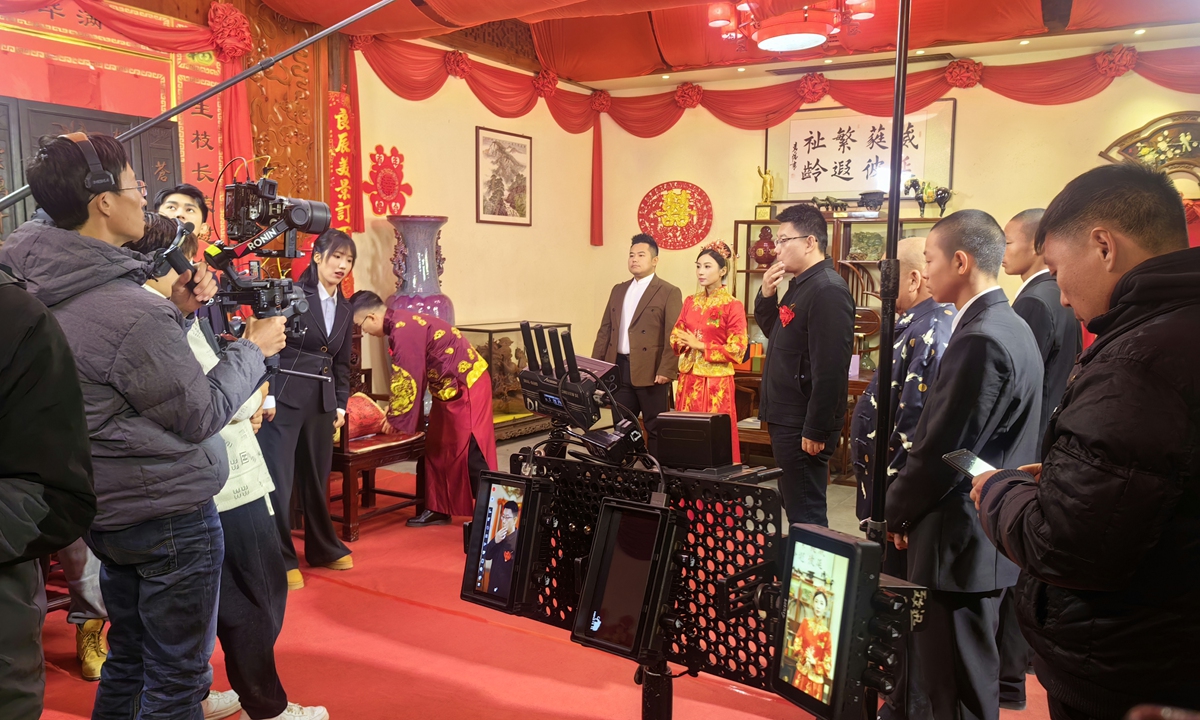
Yang Ni, a villager from Yuanqiao in Dengfeng, Central China's Henan Province, still remembers the nervous excitement of facing a slowly advancing camera for the first time. Now, she shifts with ease between roles, from a maidservant trailing a heroine in a historical drama to a famine-struck villager before the People's Republic of China was set up in 1949.
Experiencing so many lives within various screenplays, Yang said that short dramas have transformed not only her life, but also the ancient village she calls home.
Yuanqiao, a small village with a history that traces back over 600 years, has welcomed more than 70 short drama crews in recent years. The creators have captured every angle of the village's traditional courtyards, winding alleys, and gently rising cooking smoke. Locals have grown used to exchanging their daily farm clothes for costumes between busy seasons, giving life to lively townsfolk on vertical screens.
Yuanqiao village's revitalization is not just a story told through the camera lens. Si Jianbin, responsible for short drama coordination in the village, told the Global Times that the changes brought by short drama filming are visible in many ways.
With traditional buildings serving as natural film sets, once-abandoned houses, crumbling village walls, and old opera stages have been repaired and preserved. This has renewed villagers' sense of cultural stewardship. The arrival of drama crews has also broadened job opportunities for local youth; more young people are now choosing to stay or return home, breathing new life into the village.
Si noted that challenges also persist. The swift rise of AI-generated dramas is reducing demand for real-life shoots, and the number of visiting productions in the village has started to drop. Still, Si remains confident, noting that the village's authentic architecture meets the growing demand for high-quality short dramas. He said that leveraging this unique match will secure a promising future for revitalizing rural areas through film.
Changed villages
"For years, I only saw our old houses as broken-down obstacles; after filming, I realized every brick and tile is our cultural heritage," Yang said. Having played a background actor in numerous dramas - from period pieces to modern stories - she and her neighbors now see their ancient city walls, opera stages, temples, and homes through new eyes.
Some once-vacant houses have found new purpose as meticulously arranged sets, bearing witness to love stories or family feasts. One courtyard, frequently appearing in short dramas, is adorned with red lanterns and paper cuttings to express joy. Villagers redecorate it for shoots, blending cheerful ambiance with authentic period feel.
Today, Yuanqiao's residents - all from toddlers to seniors, even family donkeys and dogs - have become "stars" on camera. People farm during the busy season, then slip into costumes to perform, seamlessly shifting between fields and film sets.
Younger villagers have found new skills and work too. Si noted that more than half of local youth have acted as extras, with some job-seeking college graduates now learning editing and computer skills from the drama teams, opening the door to steady work in short film production.
The economic benefits for the village are clear. Si pointed out that village income grew from 4 million yuan ($593,330) in 2024 to over 5 million in 2025, a 20 percent of increase thanks to short drama filming. Most villagers have seen their annual incomes rise by around 5,000 yuan as a result.
Traditional crafts once on the verge of disappearing - such as paper-cutting and basket-weaving - are also reviving. Villager An Qing'e, known for her hand-woven flower baskets, was discovered by a filming crew and soon found online customers for her props.
Tourists, too, are seeing the village in a new light, as site visiting becomes an immersive experience. They are no longer fleeting passersby, but participants in the living stories of the ancient village.
The sets created for filming repurpose historical spaces, allowing visitors to step into the joys and sorrows of different eras.
This phenomenon is not limited to Yuanqiao village. The unique needs of rural and historical short dramas perfectly match the spaces and cultural resources of China's villages. Other places, such as Hujiaxi in Yuanling county, Central China's Hunan Province, and Nanhu in Jinyun county, East China's Zhejiang Province, are attracting drama crews and experimenting with a rural revitalization approach combining short drama with agricultural and cultural tourism.
Seeking the irreplaceable
Still, the path for rural short dramas is being tested by the realities of the market.
The rise of AI-generated content is quickly diverting orders away from real-location shoots. Si said that after peaking at 35 crews in 2025, the number shrank to one or two per month in Yuanqiao village by 2026.
Even so, Si sees a hopeful future. While AI short dramas win on low-cost virtual settings, China continues to encourage the creation of well-crafted real-life dramas through supportive policies.
There is a lasting appeal in the atmosphere, sense of history, and human vitality that only real villages can provide - qualities virtual images cannot match. As audiences and studios increasingly seek authenticity and quality sets, villages like Yuanqiao have lasting room to grow.
Zhang Peng, a cultural researcher and associate professor at Nanjing Normal University, told the Global Times that the rise of AI-generated short dramas is reshaping the industry. However, this does not mean villages will lose out on the benefits brought by filming. On the contrary, when the bubble fades, truly valuable villages may be in even greater demand.
Their core competitiveness is not just cheaper venues, Zhang explained, but their unique local culture, authentic lifestyle, and the fusion of online and offline tourism experiences.
"To keep these benefits, villages should not compete with AI on cost and efficiency," Zhang noted. "Instead, they must redefine their own irreplaceability in the production chain."
Ding Daoshi, a veteran internet analyst, offers a word of caution: short dramas change fast, and their impact rarely lasts as long as movies or TV series. For villages, the key to sustainable development is leaning on their unique heritage and not just short dramas.
By finding their own irreplaceable assets and combining them with the energy of film, they can secure their future for the long haul.
。
Current article:http://www.minpinpengcemiuanjiuxuan.pics/ot76/21m.pptx
Published on:14:42:31
听见你的声音_Random reading
- 08-21Patient with both legs severed at thigh level walks again after doctors perform rare replantation surgery in East China’s Jiangsu
- 08-232.5D双面玻璃,999元起:红米红饭7号,上午10:00开门
- 08-22WTI原油跌破80美元/桶!伊朗阿曼磋商霍尔木兹未来管理安排
- 08-22央视《新闻联播》:山东打造商业航天产业高地
- 08-20CENTRESTAGE to showcase 270 fashion brands to Hong Kong
- 08-20共筑防线 共享机遇——2022年国家网络安全宣传周观察_活动_新华社
- 08-26'China travel' fuels 'China shopping' boom
- 08-21Jennifer Lawrence and Josh Hutcherson to return in Hunger Games: Sunrise on the Reaping
- 08-23Nvidia图形驱动程序417.71更新:官方支持RTX 2060图形卡
- 08-22Restaurant chain Chef Fei removes controversial slogan amid online scrutiny

刑事侦缉档案4_Active users
- What the West's assimilation accusations against China reveal about its own historical burdens
- 【观点】光大期货:燃料油绝对价格仍跟随油价表现偏强
- 阔别多年再起航 10月2日起中加经典航线重归杭州
- 【品种策略】不锈钢:08月26日多家期货公司晨报观点汇总
- 巴莱巴球探报告:迟到一年的重量级签约,曼联升级换代的加速键
- 乏了!罗马诺:利物浦天天和巴黎讨论巴尔科拉,这关乎加克波去留
- 马赛球迷横幅点名批评格林伍德,前曼联锋将用梅开二度强势回应
- 【仓单】8月26日大商所玉米期货仓单较上一日增长9942手
- Rashmika Mandanna and Director Anudeep KV to Collaborate?
- 杜加里:小蜘蛛闹转会的方式极为愚蠢,未吸取格列兹曼的前车之鉴
- Akshaye Khanna’s viral Dhurandhar dance was unplanned? Find out
- 苹果的销售经历了一系列的挫折,去年iPhone的销量在印刷品上暴跌了50%。
- 微信也可以拨打110:成都市公安微信报警平台正式上线
- 出售Gigabyte RTX 2060微型显卡123:ITX单扇,3099元
- 羊了个羊被质疑抄袭,公司仅7人参保_《羊了个羊》被曝疑抄袭《3tiles》_简游
- offo与上海凤凰自行车达成和解:剩余分期付款
- 帕金斯:杰伦-格林必须站出来证明自己 不然他就得拿来交易杜兰特
- 痛风糖果竟掺处方药废料,每盒成本仅7.48元,终端零售价卖到598元,涉事企业被罚没款3.8亿余元,责任人被追究刑事责任
中国新歌声_Hottest this week
- 08-23状态火热!22岁李昊中超连续5轮零封,赛季70次扑救7场零封
- 08-24Taylor Swift & Travis Kelce’s moms take charge of the couple's three-day Rhode Island wedding
- 08-20Whoscored评本轮德甲最佳阵:凯恩&霍勒领衔锋线,基米希在列
- 08-21前苹果零售经理:苹果是未来十年你能买到的最好的股票
- 08-24上城首批60位陪诊师持证上岗 让老人就医不再独自奔波
- 08-26Home-made C919 completes first international commercial flight, lands in Ulaanbaatar
- 08-26记者:欧足联即将召开会议,讨论抵制因凡蒂诺的措施
- 08-24PowerColor发布了两款紧凑型egfx设备:带AMD RX 560/570
- 极度深寒 copyright
- Some of the content comes from the Internet. If you have any offence, please raise it.