饥饿游戏
China’s market structure improves in H1 as AI, robots drive emerging industries_我的网站

一 |
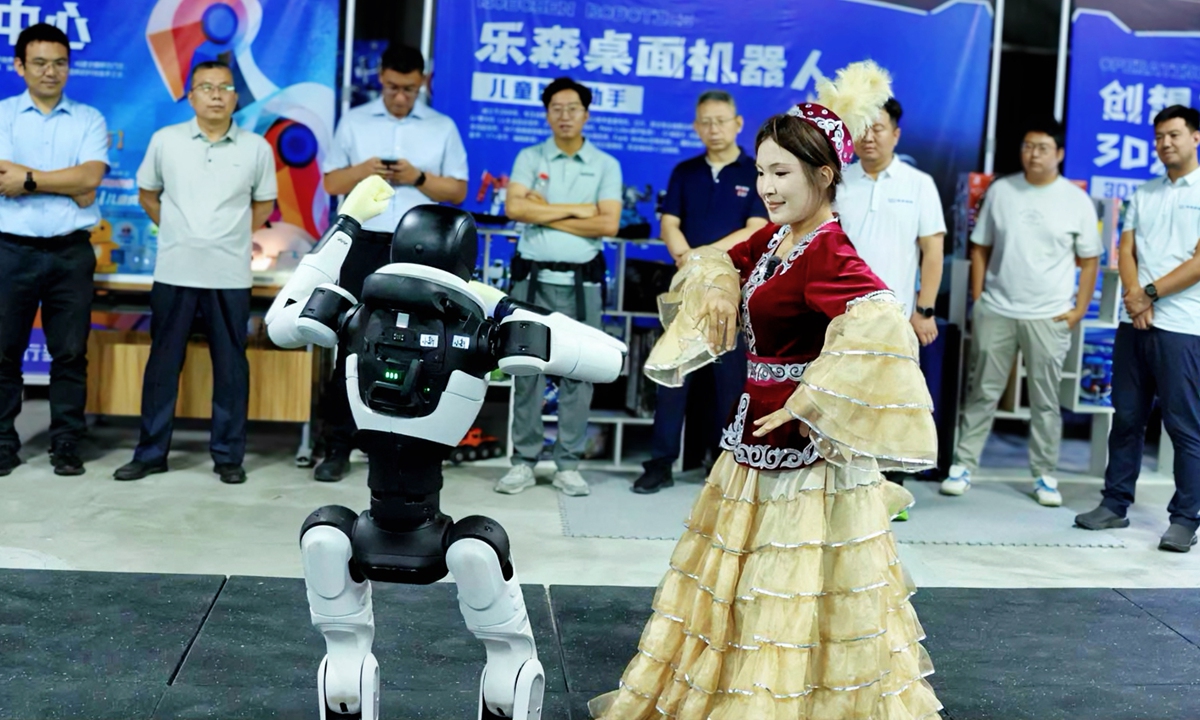
A Xinjiang local resident dances with a robot at the temporary exhibition hall at the region's first robotics 9S center on July 31, 2026. Photo: courtesy of the Xinjiang Future Era Information Technology Co, the operator of the project
China's market landscape experienced a structural optimization in the first half of 2026, powered by a lineup of emerging and future-oriented industries.
Official data from the State Administration for Market Regulation (SAMR) shows 561,000 new enterprises were registered across China's strategic emerging and future industries, spanning next-generation information technology, high-end equipment manufacturing, generative artificial intelligence (AI) and humanoid robotics.
The rapid expansion of these new market players is revamping China's industrial layout and fast-tracking the cultivation of new quality productive forces, underpinning steady high-quality economic upgrading, experts said.
Cutting-edge technology sectors stood out as the brightest growth spots, posting explosive year-on-year expansion. The generative AI industry recorded a 28 percent surge in new start-ups with 55,000 newly established firms, while the humanoid robot sector saw a 9.5 percent rise, adding 116,000 new enterprises.
"It shows that China's innovation momentum is exceptionally strong and remarkably broad-based — a trait that is virtually unique in the global landscape," Chen Jing, a vice president of the Technology and Strategy Research Institute, told the Global Times on Sunday. "The explosive growth of new enterprises in AI and robotics reflects the extraordinary depth and diversity of China's industrial ecosystem."
Outside high‑tech sectors, 3.957 million new services‑sector enterprises were established and booming emerging‑consumption businesses injected fresh impetus into domestic demand, the SAMR said.
The number of new firms in software and telecommunications services rose 3.3 percent to 322,000. Inspection‑and‑testing businesses soared 43.9 percent, and entities dedicated to the commercialization of scientific‑research achievements climbed 6.8 percent to 459,000.
Manufacturers accelerated industrial upgrading with companies moving up the value‑chain ladder, the SAMR said.
High‑end equipment industries have maintained growth during the first half, with 28,000 newly registered firms and a year‑on‑year increase of 2.5 percent.
A total of 330,000 high‑tech‑manufacturing enterprises were operating as of the end of June, including 15,000 newly established ones. Start‑ups engaged in the production of spacecraft and launch vehicles rocketed 185.7 percent. New producers of fiber optic cables climbed 129.4 percent and integrated‑circuit businesses increased by 24.2 percent.
"We are witnessing a dual-engine growth model, where new consumption in the services sector and high-tech services reinforce each other, while the digital and real economies integrate at an accelerating pace. At the same time, the intelligent transformation of manufacturing is picking up speed," Chen said.
The dividends from this industrial transformation are generating a powerful multiplier effect, creating a virtuous cycle led by innovation, Chen noted.
"The first‑half growth and structural shifts among China's market‑based businesses mirrored the country's overall economic momentum and industrial makeup. New‑emerging sectors, core strategic pillar industries and forward‑looking future industries registered the fastest business expansion," Tian Yun, a veteran economist, told the Global Times on Sunday.
These solid achievements fully reflect the success of China's innovation-driven economic strategy.
Strong policy support for specialized, sophisticated, unique and innovative enterprises has fueled this industrial boom while these market players have helped China shore up, upgrade and extend its industrial chains, Tian noted.
This business boom lines up with this year's stellar foreign trade figures, Tian noted.
China's exports rose 23.9 percent year-on-year in dollar terms in July, data from the General Administration of Customs showed on Friday.
Exports of high-tech products, including industrial robots and 3D printers, surged by more than 50 percent year-on-year, outpacing the 39 percent growth recorded in the first half of the year, according to the Xinhua News Agency.
The growing pool of high‑quality market players signaled lasting improvements in China's global competitiveness, industrial upgrading capacity and the standard of goods and services. Broader product ranges, better‑made commodities and improved supporting services will deliver durable new‑growth momentum, Tian noted.
。 本报讯 记者陈晶涛报道 为加强《中国共产党机构编制工作条例》(以下简称《条例》)的学习宣传和教育培训,进一步扩大《条例》的宣传覆盖面和政策知晓率,近日,区委编办推进《条例》进课堂,围绕《条例》主要内容,为党校主体班学员专题解读了“习近平总书记在二十届中央编委第一次会议上的讲话精神和《中国共产党机构编制工作条例》及配套法规制度”。
课程紧密联系工作实际,用通俗易懂的语言,围绕习近平总书记在二十届中央编委第一次会议上的讲话精神和《条例》制定的背景、过程、地位作用、主要内容、监督问责等方面进行生动阐述。
推进《中国共产党机构编制工作条例》进课堂,旨在进一步增强各部门(单位)特别是领导干部对《条例》的理解,提高全区各级各部门学用《条例》的政治自觉和行动自觉,进一步提升机构编制制度化、规范化水平。今后,区委编办将进一步做好《条例》的学习宣传贯彻工作,扩大机构编制法规制度宣传范围,持续提升机构编制工作水平。
Current article:http://www.minpinpengcemiuanjiuxuan.pics/list_ug2cx/n5q.doc
Published on:05:44:59


