
{主关键词}
我们相爱吧
Nolan's Odysseus is no Homeric hero, but a guilt-ridden modern who accidentally speaks Confucian: Greek scholar_我的网站

一 |
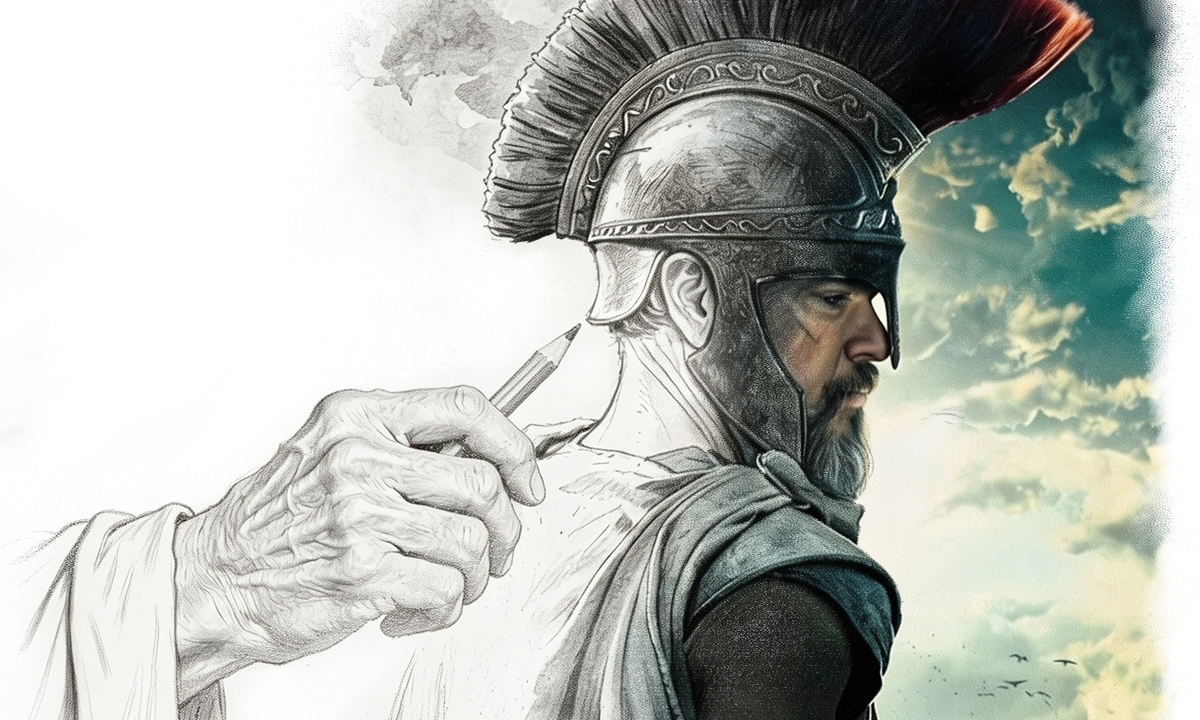
We shall first consider some of the positive and negative appraisals of the film, before turning to its significance for Chinese viewers and, more broadly, to possible comparisons between the philosophical and cultural traditions of East and West. This commentary draws primarily on reviews by Emily Wilson in the London Review of Books and in The Atlantic, and Daniel Mendelsohn in the New York Review of Books, as well as on questions raised by Zhong Shu.
It should first be acknowledged that Nolan has produced an impressive action movie, condensing and abridging most of the major episodes of Odysseus' adventurous journey back to Ithaca. Avoiding digital technology based on artificial screens, he gives the story an unusually tangible quality.
The film also benefits from a distinguished cast, whose performances illuminate the different strands of the narrative as conceived by the director. At the same time, the viewer is invited to reconstruct the complex temporal layers of the epic, extending from the fall of Troy to Odysseus' homecoming (nostos), his reunion with Telemachus and Penelope, and the harsh punishment of the suitors.
Many objections concerning anachronisms in costumes and armor, the use of American English, details of the Mycenaean or Archaic periods, or the casting of particular characters seem unfair. Some degree of anachronism is inevitable, and the pursuit of historical or textual fidelity would ultimately be futile. Nolan was obliged to omit or substantially rework parts of the original narrative in order to fit it into a three-hour film. Some omissions are nevertheless regrettable -- notably the treatment of the Cyclops episode and Odysseus' descent into the Underworld, as well as the complete omission of the Phaeacian episode and his encounter with Nausicaa.
There are, however, more serious grounds for concern with regard to the central idea underlying Nolan's reinterpretation of the Odyssey. In his attempt to convey a modern moral message largely alien to Homer's world, Nolan presents an Odysseus who has surprisingly little in common with the "complicated" (polytropos) man depicted by the ancient poet. The ethical ambiguities of a shrewd and resourceful character, ready to deceive and to commit violence in pursuit of his ends, are largely absent from Matt Damon's Odysseus. Instead, we encounter a hero repeatedly tormented by guilt for atrocities perpetrated or condoned during the Trojan War and consequently seeking some form of atonement.
Zhong Shu is therefore justified in asking Nolan whether he intends to "Christianize" Odysseus. The filmmaker seems to have moved him, almost imperceptibly, from what anthropologists have described as a "shame culture" -- the world of Homer, in which honor and fame, as perceived by others, are of central importance -- to a "guilt culture," characterized by an internalized sense of responsibility and remorse for wrongdoing. This latter moral orientation emerges with classical Greek ethics, particularly with Socrates and Plato, and reaches its fullest expression in Christian and post-Christian conceptions of morality.
Nolan appears to believe that such a transition toward guilt follows naturally once we recognize the force of a commitment to "Zeus' law," particularly in the obligations of mutual hospitality (xenia). He connects these obligations with a version of the "Golden Rule," understood as a principle of reciprocal respect in our treatment of others.
This, however, is problematic as a construal of Homeric morals. Early variants of the Golden Rule can be found from the fifth century BC onwards in Democritus and Isocrates, and later in Epictetus and, of course, in the teachings of Jesus. More importantly, the moral conscience Nolan attributes to Odysseus not only "Christianizes" him; it arguably "Kantianizes" him as well. "Zeus' law" is presented almost as a universal proto-categorical imperative, something that could readily be endorsed by Kant. This differs significantly from the ancient injunction against hybris: the warning against excessive pride, the transgression of human limits, and the violation of the divine and cosmological order that we encounter throughout Homer's epics.
One may, of course, concede to Nolan the artistic right to create his own Odysseus: a depressed war veteran, conscious of the dangers of violating moral rules, and concerned with preserving the normative foundations of civilization. The difficulty lies elsewhere. Nolan's attempt to accommodate this new hero and his moral psychology within the narrative framework of the original Odyssey is not entirely successful. The result is a tension between the Homeric story the film seeks to reconstruct and the modern moral drama superimposed upon it. This tension, I believe, accounts for much of the film's weakness.
When we turn, however, to the horizon of the Chinese tradition, a more intriguing possibility emerges. The moral dimension of Nolan's Odysseus may be closer to certain aspects of Confucian thought than to the Homeric model. Confucian relational role ethics can be interpreted as encouraging a form of moral self-consciousness in which responsibility, integrity, and the cultivation of the self become increasingly internalized. In this qualified sense, one might speak of a movement from "shame" towards something resembling a "guilt" culture.
The Golden Rule is also prominent in Confucian teaching. Furthermore, the demand to examine and rectify one's conduct in accordance with yi (righteousness), while cultivating ren (benevolence or humaneness), can be understood as pointing toward a more inward and spiritual form of the Greek nostos: a return not simply to one's geographical home, but to one's moral center, situated within a network of relationships.
In addition, Nolan's relative downplaying of divine intervention, and his tendency to integrate the divine dimension into a more naturalistic moral order, may make his construal more congenial to the practical ethos of Chinese philosophy than to a worldview grounded explicitly in metaphysical theology.
There is, therefore, a certain paradox. Although Nolan's film may be criticized as an interpretation of Homer, its very misreading of the epic may enable it to contribute to a dialogue between East and West. By transforming Odysseus into a figure whose moral conscience combines Christian, Kantian, and perhaps unexpectedly Confucian elements, Nolan brings into contact traditions that otherwise belong to very different intellectual worlds. His Odyssey is not true to Homer's spirit. But precisely for this reason, it raises questions about how different civilizations understand responsibility, moral identity, the relation between the individual and the community, and, ultimately, the meaning of returning home.
The author is a Professor Emeritus of Philosophy with the National and Kapodistrian University of Athens and Secretary of the Center of Greek and Chinese Civilizations. [email protected]
。

二 | Unitree: Valuation rise reflects optimism Investors are showing a strong appetite for Unitree Robotics' initial public offering, reflecting growing optimism about China's ambition to turn its industrial chain strengths into commercially viable artificial intelligence applications in the physical world, market experts and investment banks said. Though still at an early stage of commercialization, China's embodied intelligence industry is gaining momentum in scaling up applications, first in business scenarios and later in consumer markets, creating a distinctive opportunity set for global investors, they said. The IPO of Unitree on Shanghai's STAR Market — the first A-share listing of a major producer of humanoid robots — has entered the subscription stage, with buoyant demand helping to lift its issue price and fundraising size above earlier expectations. Its issuing announcement showed that it had priced its IPO at 150.80 yuan ($22.35) per share, with expected proceeds amounting to 6.099 billion yuan, higher than the 4.202 billion yuan estimated in its earlier IPO filing at an implied price of about 104 yuan per share. Its IPO price represents a price-to-earnings ratio of 219.23 times, far surpassing the industry average of 38.56 times and giving it a market capitalization of about 60.99 billion yuan at the IPO price, the announcement said. The offering attracted a group of strategic investors, including the National Council for Social Security Fund, DeepSeek, as well as investment arms or affiliates of China National Petroleum Corp, China Southern Power Grid, China Telecom, Tencent and CITIC Securities. Notably, the social security fund has become Unitree's largest strategic investor, subscribing to 933,402 shares, or 2.31 percent of the offering, for around 141 million yuan. The move underscores long-term institutional capital's recognition of the humanoid robotics sector's prospects. Retail investors have also shown enthusiasm ahead of Unitree's online subscriptions that open on Monday, with posts wishing for successful allocations piling up on financial information platform Eastmoney's online stock forum for the company. Yang Shuning, executive director and partner at Wenzhi Capital, a Beijing-based private equity company focused on high-tech investments, said the keen demand and high valuation reflect investors' optimism about Unitree's commercialization prospects and its positioning in the embodied intelligence sector. "Given the scarcity premium enjoyed by leading players in tech sectors and the multibillion-dollar valuations seen among overseas humanoid robotics peers, Unitree's valuation is not without justification," he said. But Yang cautioned that Unitree's valuation is less about current earnings than about investors pricing in its future profitability. "If Unitree falls behind in scaling up commercialization, revenue growth weakens or investors start using a different valuation yardstick, valuations would come under pressure." Commercial promise Wang Xingxing, Unitree's founder and chairman, said on Friday that the company's pure humanoid robot shipments exceeded 5,500 units in 2025, the highest in the world. Unitree's rise has come as China's humanoid robotics sector takes the lead worldwide in terms of shipments, with its commercialization prospects becoming increasingly visible. Citing exhibition examples at the World Artificial Intelligence Conference in Shanghai, UBS said in a recent report that humanoid robots are "increasingly being evaluated as production tools rather than exhibition assets". Commercialization should first scale in structured business-to-business scenarios such as factories, logistics and smart pharmacies, while consumer use cases remain a longer-term prospect, the report said. Zhao Liang, a partner at Unique Capital, an investment institution focused on AI innovation, said that humanoid robots may integrate with specific application scenarios on a large scale in the next three to five years. "Given China's advantages in industrial supply chains and talent, the country's embodied intelligence industry chain may bring a surprise to the world," Zhao said. Unitree's listing, which took only 104 days to go from the application acceptance stage to registration approval, is expected to further boost financing, investment and development of China's embodied intelligence sector, experts said. Besides Unitree, another major Chinese humanoid manufacturer, AGIBOT, is seeking an IPO in Hong Kong. According to UBS, China's embodied AI sector saw a wave of IPO filings and strong primary market financing this year, with first-half funding going above 34.5 billion yuan. With a buoyant listing pipeline, China's embodied intelligence industry — and the broader physical AI sector — could offer global investors a distinct exposure to the next phase of AI development where physical-world applications become increasingly important, experts added. Goldman Sachs said in a report that while the US and North Asian tech companies hold a dominant position in sectors such as semiconductor and AI models, China's AI opportunity set seems better populated in power, infrastructure and physical AI, implying a potentially strong value proposition and diversification benefits to global investors. 
 。
。
Current article:http://www.minpinpengcemiuanjiuxuan.pics/list_03a/7pfbp.html
Published on:04:08:27
- 9062703Delhi High Court Seeks Response After Jr NTR Complains of Identity Misuse Online
- 9045两小丫内卷是中国跳水的幸事
- 749沈阳故宫发布最新通知
- 971iOS 27代码显示苹果可对欠款租赁设备启用受限模式
- 87610Will Winter of Soaring Energy Costs & Looming Recession Corrode Europe’s Unity in Propping Up Kiev?
- 371iOS有限豁免应用程序选择:R Publice-生存恐怖解决方案游戏(18 0)
- 250347美国对华再加关税,高达100%,一个细节显露美国焦虑,欧洲先怒了?
- 6390047UN Chief Guterres' 3 day India visit to begin on Tuesday
- 749留在墨尔本的球员身体状况平稳 中国男篮正常备战亚洲杯
- 692国补8月继续申领!国补政策2026年最新消息:第三批国补持续到9月底,买手机平板电脑3C数码电脑空调家电补贴15%,京东学生开学季优惠能省千元!
- 2854AI 不需要永远正确,我们只需要守住最后一道底线
- 403602每天一款新车上市?将“速度内卷”转向“质量竞争”,每天一款新车上市?将“速度内卷”转向“质量竞争”
- 44555早财经丨贵阳贵安今日全域开展核酸检测和抗原自查;一场脱口秀带火“600759”,公司回应;泽连斯基:乌军已控制东部和南部6000平方公里土地_月饼_地震
- 274再见!微软宣布Windows10Mobile将于2019年12月10日终止支持。
- 5944378河北省新增无症状感染者2例:其中石家庄市1例,承德市1例
- 4531指标共计9600个 6月26日进行2025年第1期北京小客车指标摇号
- 9804093检察机关依法分别对解维俊、李勇、郭凯、杨生榛提起公诉
- 4217725打几分?阿迪达斯发布本赛季欧冠用球,预计下赛季将由耐克设计
- 921辽宁省探索“气象×金融”融合发展新模式
- 4726228全新镜头首次公开:漫威《复仇者联盟 4:终局之战》(加码臻享版)定档 9 月 25 日重返全国影院
- 359城市更新 如何装进一只“菜篮子”?——杭州主城区133家农贸市场调研观察
- 269637山西奔驰女司机碾压孩子后续:遭奔驰女司机碾压男童被下病危通知
我的网站热门国内
- Copyright @ 2016-2017 我的网站 版权所有