
豪杰春香
Restoration brings endangered egrets to China’s Yellow Sea coast_我的网站

A |
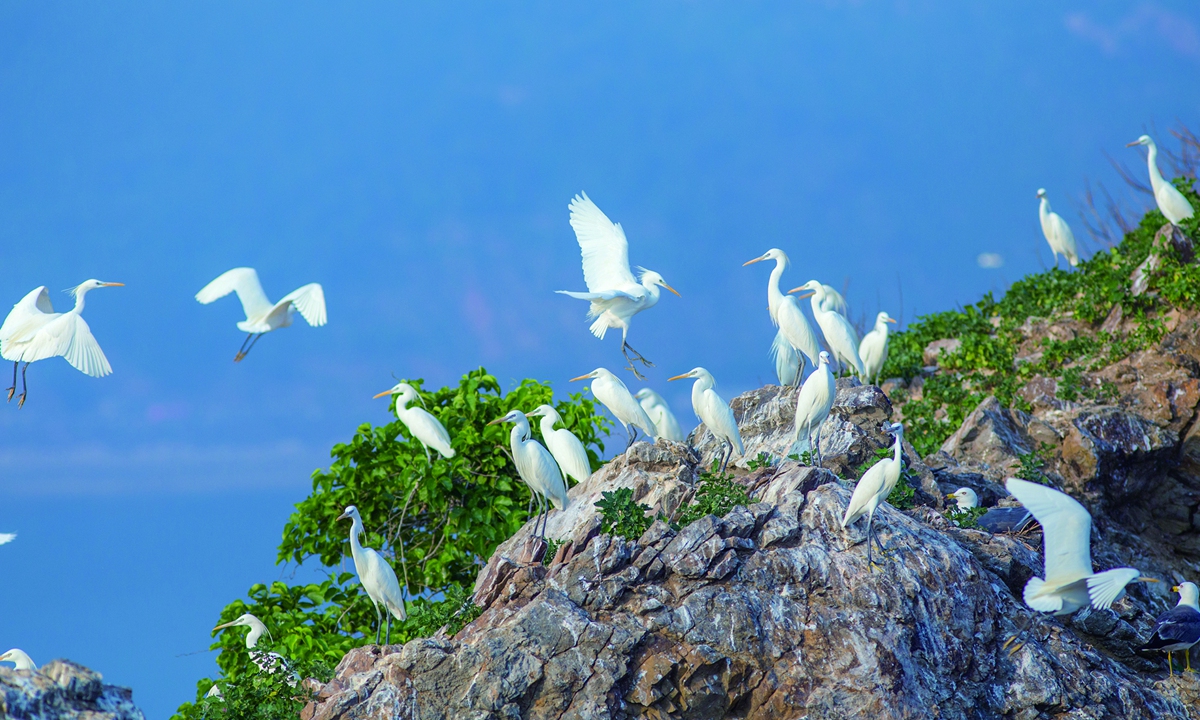
At 5 am, Wang Piyu, deputy director of the Changhai County Natural Resources Affairs Service Center, sets out by patrol boat for Fantuozi Island, a core breeding site for Chinese egrets in the Changshan Archipelago, Northeast China's Liaoning Province. The island has no permanent residents.
About 100 meters from the island, Wang turns off the engine and reminds accompanying researchers to keep their voices low to avoid disturbing the nesting birds.
Stepping onto the island, they walk along paths covered with vines. Scattered across the rocky slopes are nests measuring 40 to 50 centimeters in diameter. Inside, fluffy chicks huddle together among soft grass woven into nests, while adult birds perch high in the trees, watching cautiously.
"This was not what the island looked like 10 years ago," Wang recalled. "People used to collect eggs here, and coastal aquaculture polluted the tidal flats. Many parts of the island were bare, leaving little vegetation for birds to nest."
The recovery of Changshan Archipelago, however, has turned the remote archipelago into an important link in global conservation efforts.
At the 48th session of the UNESCO World Heritage Committee in Busan, South Korea, the boundary modification of the Migratory Bird Sanctuaries along the Coast of Yellow Sea-Bohai Gulf of China was approved, officially adding the Changshan Archipelago to the World Heritage site.
The expansion further strengthens the integrity of the serial natural heritage site, following a previous update in 2024, and highlights China's efforts to integrate coastal ecosystem conservation, according to the National Forestry and Grassland Administration.
Behind the World Heritage recognition lies years of conservation work involving local authorities and island residents.

Located in the northern Yellow Sea off Dalian, the Changshan Archipelago sits along a key route of the East Asian-Australasian Flyway, providing an essential stopover where tens of millions of migratory birds replenish their energy during their journeys across the Bohai Sea.
The newly added area covers more than 4,900 hectares and is home to more than 140 recorded bird species, including the Chinese egret and black-faced spoonbill, both listed as China's national first-class protected animals.
In 2015, more than 300 Chinese egrets arrived in Changhai county. After discovering the birds, local authorities introduced a series of protective measures, including establishing patrol teams and installing remote monitoring systems to reduce human disturbance.
However, the growing bird population also created new challenges.
Less than half of Fantuozi Island was covered by shrubs, which serve as the nesting grounds for the egrets. Additionally, the island's poor soil and acidification caused by years of accumulated bird droppings had led to the withering and death of some shrubs in recent years.
From 2022, the county launched an ecological restoration project, replacing surface soil with fertile earth and planting more than 2,200 shrubs.
The efforts helped restore the breeding habitat. The number of Chinese egrets on the island has since recovered, with this year's population estimated at about 3,500, including around 1,500 adults and nearly 2,000 chicks, according to Lü Yongquan, director of Changhai county's natural resources bureau.
"Chinese egrets are highly sensitive to water quality, vegetation and human disturbance. Their return to breed here is a sign that the marine ecosystem has recovered and is thriving," Lü told the Global Times.
From fishermen to guardians
Conservation in Changhai is not only carried out by authorities. Local communities have also gradually become part of the protection network.
Authorities have expanded public awareness campaigns and strengthened patrols. Because most of the Changshan Archipelago is uninhabited, drones, fixed-point infrared cameras, and on-site inspections are used to monitor the islands and reefs around the clock.
Many fishermen who once relied on the sea for their livelihoods now help protect it.
During the peak breeding season from April to July, regular marine patrols are carried out to protect nesting sites and prevent illegal egg collection and habitat damage. Local bird conservation groups and research institutions have also joined the efforts, while fishermen have taken on new roles as volunteer guardians of the islands.
Across Changhai county, many fishermen now actively participate in coastal patrols to help protect the archipelago's biodiversity.
For Li Qingsen, a 50-year-old island native and member of the county's forest fire brigade, protecting the birds has become a way of life.
From spring to autumn, 20 team members take turns staying on Fantuozi Island in pairs to protect the birds from disturbance.
Life on the 0.08-square-kilometer island is far from easy. There are no freshwater sources or docks. Patrol workers carry large barrels of water and wade ashore from boats anchored offshore. Instant noodles are often their main food because they require little preparation and some water.
Their work is closely tied to the seasonal cycle of the birds. Each April, thousands of Chinese egrets arrive in the archipelago from Southeast Asia to breed and rear their young, staying until early September before migrating south for the winter.
At present, young egrets are already practicing flight above the treetops. By autumn, they will join their parents in a southward migration.
For Wang, who has spent half of his life guarding Fantuozi Island, the World Heritage recognition is both a homecoming for the birds and a reward for years of protection. "Now, it is a home for the birds, and a reward for all the years we have spent protecting it."
。 AI摘要 2026年第三届闽台甘国宝武术文化周在福建屏南启动。两岸542名运动员以武会友,借甘国宝文化纽带深化交流,推动两岸文化体育融合及青年互动。

B | 海峡导报讯(记者 叶雨欣 文/图)8月20日,第十四届海峡青年荟·2026年第三届闽台甘国宝武术文化周在宁德市屏南县启动。活动以“武福临门 两岸同源”为主题,会聚两岸武术精英、青年代表与文化学者,以武会友、以文润心,搭建两岸深度对话交流的文化纽带。 当日上午,启动仪式在屏南第一中学举行。开场舞《武福屏南》将潮流街舞与传统武术巧妙融合,赢得满堂喝彩。随后,海峡两岸特色武术展演、宗亲联谊仪式及歌曲《陈母问勇》轮番登场,现场气氛热烈。启动仪式后,武术交流赛正式开赛,两岸52支代表队、542名运动员围绕武术套路和健身功法展开激烈角逐。 清代名将甘国宝出生于屏南,曾两度戍守台湾,其保台卫疆的事迹至今仍为两岸民众所铭记。

C | 来自台湾的甘氏宗亲代表甘能政表示,甘国宝的故事深深烙印在许多台湾同胞的成长记忆中,他身上所展现的忠诚、勇敢与智慧,至今仍激励着后人。他说:“场上比功夫,场外交朋友,武术是两岸共同的语言。通过这样的平台,两岸同胞心更近、情更浓。” 近年来,屏南县以甘国宝武术文化为情感纽带,先后打造“福建省对台交流基地”“福建省闽台姐妹合家园”“闽台青年乡建乡创驿站”等一批省级对台交流阵地,持续深化两岸青年交流交往,架设起两岸文化交融、乡创共建的沟通桥梁,绘就两岸同源共生、携手发展的生动图景。
Current article:http://www.minpinpengcemiuanjiuxuan.pics/eobsb/py2etzj.pptx
Published on:02:52:34
我的网站最近更新
- 三星S10单独运行:路龙8556 GB内存,多核突破10000
- 美国国务卿确定了乌克兰新选举的条件
- Ethiopian Airlines Pilots Fell Asleep Flying at 37,000 Feet, Reports Say
- 长江存储IPO幕后:武汉20多年前押注芯片行业,是复制“合肥模式”?
- 月之暗面:第一代万亿参数多模态模型Kimi K2.5本月底即将结束服役
- Filming Starts For Gautham Karthik’s New Project
- 发挥侨商资源优势 浙江绍兴“百侨助百村”同行共富路_侨资_企业
- 黄山旅游2026年上半年净利润1.3亿元,同比增长2.9%
- 最好的夏天,目标:买下东京!乌克兰人做的昭和模拟《东京股神》史低折扣倒计时!
- 湖人大概率送出哈迪与克内克特 谋求得到库明加
- 新iPhone涨价多少?折叠屏令人兴奋?知名爆料人这么说
- 【牢记嘱托 感恩奋进 奋力谱写中国式现代化建设河北篇章】“一季雪”变“四季热” 后奥运经济动能澎湃
- 大陆产业升级释放新机遇 两岸专家吁深化合作
- 起亚全新赛图斯车型上市:蔡徐坤代言,一口价 7.99 万元起
- 温润玉溪 旅居福地丨一馆藏菌韵 读懂菌乡易门
- 浙江省委书记王浩主持召开省委专题会议 研究台风“沙德尔”防御应对工作
- 京津冀将完善脑机接口产业基础技术、应用标准体系
- 太怪了!《GTA6》泄露者为何只玩男主不见女主?
- 豆瓣8.7分今年最强口碑电影!《欢迎来龙餐馆》官宣全球上映计划
- 产业发展开新局丨“双谷”齐发力 读懂安徽的创新引擎
- 杰登·哈迪:东契奇乐于提携后辈 是年轻人的后盾
- 重庆唯一具备周调节能力的抽水蓄能电站项目取得关键节点突破,重庆唯一具备周调节能力的抽水蓄能电站项目取得关键节点突破
- 乌克兰停火提议被拒,普京开出更高价码,这场博弈中,基辅先露了怯,兵器展望,原创 乌克兰停火提议被拒,普京开出更高价码,这场博弈中,基辅先露了怯
- The Parasite-Infested Giant African Land Snail is Back in Florida
我的网站热门资讯
- 一家族三代村医,八十年接力守护海岛
- 科比48岁生日 球迷送祝福“老大生日快乐”
- Final arguments are being made before Australia's vote to create Indigenous Voice
- Strike talks break off between Hollywood actors and studios
- 从雪道到山野 吉林“轻极限”运动撬动暑期文旅经济
- 官方:曼城新援布阿迪将身披俱乐部32号球衣
- 养眼!赵继伟娇妻晒怀抱鲜花美照 光影明暗有电影质感
- 比亚迪 × 荣耀达成深度手车互联合作,地址流转一拖即达、音乐无缝流转
- 每日优鲜被指清空商品信息与用户余额,回应:系统服务器故障_App_财经
- 未来科技传播曝光OPPO邀请函:10倍无损变焦即将到来
- 华为没有放弃“5G”:华为 Mate 50 5G 手机壳曝光,10月上线_系列_通信
- 新款特斯拉Model S/Model X在美上市 约合人民币60.99万/64.58万
- China's digital industry revenue tops 20 trillion yuan in H1
- 男子吃了眼镜蛇后反手举报商家卖野味,双双被罚
- 生意社2026年8月26日玉米行情观点:震荡运行
- 《GTA6》遭超大泄露!R星愤怒抓捕泄密者 遭疯狂玩梗
- 明起大转折!杭州强降雨进入尾声 部分地区仍需注意
- 芽笼公园连道新增1.2公里 即日起向公众开放
- Chinese researchers identify target to develop depression drug using traditional ethnic medicine in Yunnan
- “5児の父”「杉浦太陽」の愛車「“1000万円超え”トヨタ車」に反響止まず! 豪華ウッド内装の「7人乗り国産車」に「うらやましい生活」と憧れの声も! 人気ファミリーに寄せられた“熱視線”とは
- 区妇联开展在职党员进社区活动
- 文旅新探 | 打卡“龙餐馆” 读懂一座西北矿区的光影新生
- AI带货须亮明“身份”
- 最强可达超强台风级!“沙德尔”会登陆我国吗?最新研判→